


JONATHAN GREEN & SONS INC 12400 Jonathan Green (12400) Winter Survival Fall Lawn Food - 10-0-20 Fall Lawn Fertilizer (5,000 Sq. Ft.) (EA)
Jonathan Green Winter Survival Fall Lawn Food is the ideal fall lawn fertilizer to spread anytime from early September through mid-November because air temperatures are cooler and the soil is still warm enough for grass roots to grow deep. Winter Survival provides the nutrients to help boost newly seeded lawns as well as help established lawns grow thicker and greener grass with deeper roots. This product helps lawns recover from summer stress, feeds grass for up to three months and can be applied to any type of lawn grass. If Winter Survival is spread early in the fall, a second application the first week of November will safeguard the lawn over the winter resulting in greener grass early next spring. Use a rotary or drop lawn spreader. Check that the spreader opening at the bottom of the hopper is closed. To select the proper spreader setting see the Spreader Settings section in the accordion below. Push the lever forward only when ready to spread. Apply fertilizer around the perimeter of the lawn to establish a turning area. Then run the spreader back and forth within the area outlined by your first perimeter application. Always allow an overlap to avoid gaps in coverage. To avoid staining, sweep any excess fertilizer granules off of hard surfaces and back onto the lawn. Irrigate the treated area after application for best results. About 1 1/2 inches of water per week is sufficient between rainfall and irrigation but not to the point of run-off. Once watered wait a day to mow the lawn, allowing the product time to activate.
$25.99
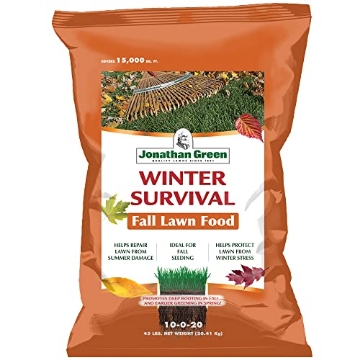
JONATHAN GREEN & SONS INC 12414 Jonathan Green (12414) Winter Survival Fall Lawn Food - 10-0-20 Fall Lawn Fertilizer (15,000 Sq. Ft.) (EA)
Jonathan Green Winter Survival Fall Lawn Food is the ideal fall lawn fertilizer to spread anytime from early September through mid-November because air temperatures are cooler and the soil is still warm enough for grass roots to grow deep. Winter Survival provides the nutrients to help boost newly seeded lawns as well as help established lawns grow thicker and greener grass with deeper roots. This product helps lawns recover from summer stress, feeds grass for up to three months and can be applied to any type of lawn grass. If Winter Survival is spread early in the fall, a second application the first week of November will safeguard the lawn over the winter resulting in greener grass early next spring. Use a rotary or drop lawn spreader. Check that the spreader opening at the bottom of the hopper is closed. To select the proper spreader setting see the Spreader Settings section in the accordion below. Push the lever forward only when ready to spread. Apply fertilizer around the perimeter of the lawn to establish a turning area. Then run the spreader back and forth within the area outlined by your first perimeter application. Always allow an overlap to avoid gaps in coverage. To avoid staining, sweep any excess fertilizer granules off of hard surfaces and back onto the lawn. Irrigate the treated area after application for best results. About 1 1/2 inches of water per week is sufficient between rainfall and irrigation but not to the point of run-off. Once watered wait a day to mow the lawn, allowing the product time to activate.
$56.99
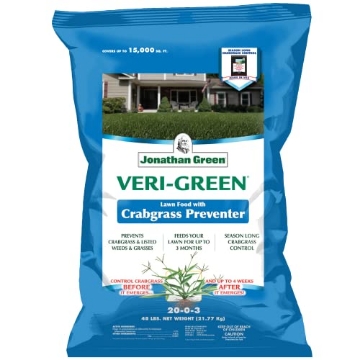
JONATHAN GREEN & SONS INC 16001 Jonathan Green (16001) Veri-Green Crabgrass Preventer Plus Fertilizer - 20-0-3 Lawn Fertilizer & Crabgrass Killer (15,000 Sq. Ft.) (EA)
Jonathan Green Crabgrass Preventer plus Green-Up Lawn Fertilizer feeds the lawn for up to three full months and provides pre-emergent control of crabgrass. When applied prior to germination it controls other weeds such as goose grass, dallis grass, chickweed, henbit and oxalis. This product contains an advanced herbicide known as Dimension that provides postemergence control, meaning it will kill existing weeds, such as crabgrass, even after they germinate. Postemergence control is limited to crabgrass and is effective for up to four weeks post-germination. It will only kill the plant up to the 3-leaf stage of growth; a fully mature crabgrass plant has 7-leaves. Thoroughly irrigate the treated area after application for best results. About 1-1/2 inches of water per week is sufficient between rainfall and irrigation, but not to the point of run-off.
$74.99

